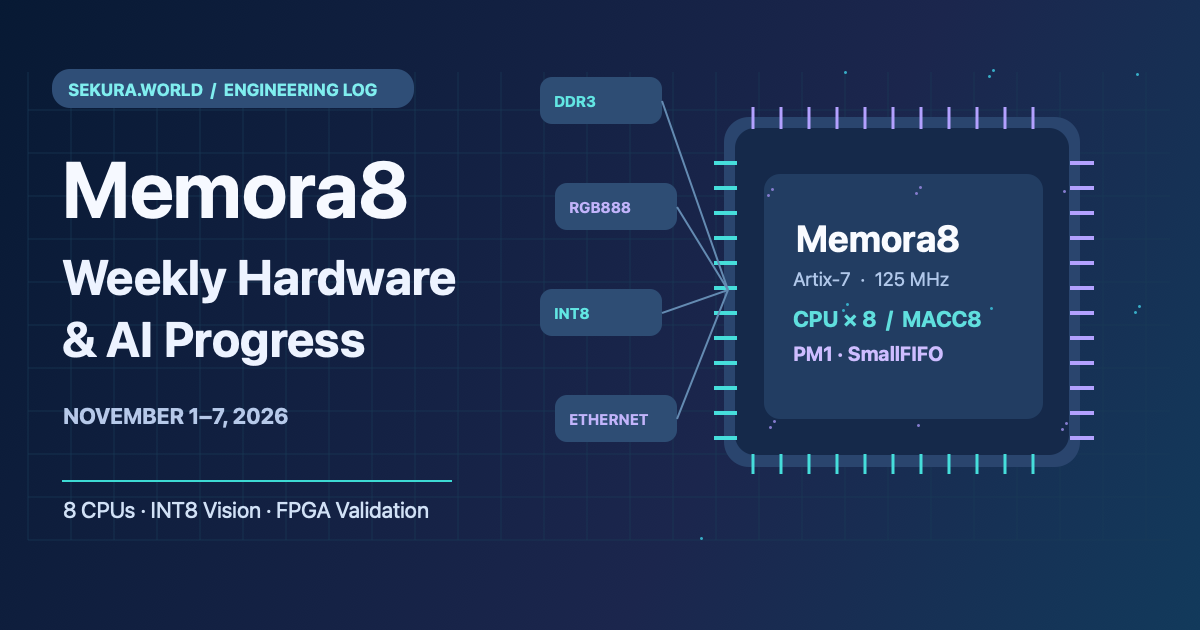
Memora8 weekly FPGA engineering illustration showing an eight-CPU Artix-7 system, MACC8, DDR3, INT8 vision, Ethernet, and SmallFIFO.

Memora8 Weekly: MobileNetV3 INT8, MACC8 and FPGA Tests

A detailed November 1–7 engineering review of the Memora8 eight-core Artix-7 platform: adapting MobileNetV3 Small to RGB888 and signed INT8, verifying 3,072,000 first-layer values, measuring PM1/MACC8 overlap, implementing eight SmallFIFOs, isolating an Ethernet System Bus blocking path, diagnosing high-address SD writes, and validating SPI Flash boot, physical Ethernet and 125 MHz timing.

Nov 7, 2026 · 30 min · Akhat T. Kuangaliyev

Memora8 MACC8: INT8 Computation, Memory Bandwidth, and FPGA Timing — A One-Week Optimization Study

The final Memora8 MACC8 configuration uses 16 parallel signed INT8 multiplications, a 128-bit datapath, four dedicated 8 KiB SRAM pages, and a 128-bit PM1 DDR3 transfer interface. Eight partial-result modes and a 128-entry FIFO provide asynchronous execution and result collection. The complete Artix-7 XC7A200T design closes timing at 125 MHz with +0.050 ns setup slack. On-board measurements reached 0.352 GMAC/s for freshly loaded 16 KiB operand pairs and 0.628 GMAC/s when reusing one operand page, including the DDR3 transfer and CPU control cycle.

Nov 2, 2026 · 36 min · Akhat T. Kuangaliyev

Memora8: One Week of Simulator Alignment and Formal CPU Verification

During October 19–25, Memora8 advanced its independent C++ emulator and the formal verification of its SystemVerilog RTL. mr8sim gained a more faithful eight-stage pipeline, per-page SRAM port arbitration, word-streamed PageMover and a persistent sparse 8 GiB SD image. Static and dynamic Sekura JS programs passed language tests; selected RTL/C++ traces matched 22/22 and 16/16 COMMIT events. The open Assurance Memora8 repository records 859 proved obligations, 51 expected counterexamples and 51 SJP packages for scoped properties across all 32 opcodes.

Oct 25, 2026 · 11 min · Akhat T. Kuangaliyev

qNac: High-Precision Mathematics Without an FPU for Memora8

qNac is a Sekura JS mathematical library for Memora8 that implements qNac64 and qNac32f using integer instructions, multiword arithmetic, and CORDIC algorithms. Simulator benchmarks report qNac32f at 11.83× the speed of qNac64 for one 1,300-check workload; the result is specific to that test and is not a hardware FPU comparison.

Oct 18, 2026 · 8 min · Akhat T. Kuangaliyev

Memora8: Eight-Core FPGA System Fits Artix-7 200T

On October 17, 2026, the complete Memora8 digital architecture passed synthesis, placement, routing, and timing analysis on an Artix-7 XC7A200T. This report covers the eight-core processor cluster, 1 MiB SRAM, System Bus, planned peripheral logic, the LOAD/STORE pipeline redesign, and implementation results: 90.2% LUT use, 84.5% Block RAM use, and +0.030 ns WNS. The bitstream was generated, while validation of external devices on the physical BX72 board remains future work.

Oct 17, 2026 · 24 min · Akhat T. Kuangaliyev

Memora8: One Week of Building an Eight-Core FPGA Computer

From October 3 to 10, 2026, Memora8 added physical microSD, UART, and GPIO tests, integrated BLAKE3 and Ed25519 VERIFY, and optimized PageMover while retaining a routed 125 MHz eight-core Artix-7 build. This report summarizes the measured results and the next steps: a custom Ethernet controller and incremental formal verification.

Oct 10, 2026 · 7 min · Akhat T. Kuangaliyev

Memora8 FPGA Implementation: 8-Core Artix-7 Status

As of October 4, 2026, the Memora8 FPGA implementation combines eight 32-bit CPU cores, 1 MiB of banked SRAM, MMU page windows, SYSTEM BUS devices, PageMover, DDR3/MIG connectivity, and UDP debug for the BX72 Artix-7 XC7A200T. The completed routed build meets 125 MHz timing, but the reported integration tests use a simulated DDR3/MIG and bypass physical Ethernet MAC/RGMII; board-level operation and the planned cryptographic accelerators remain future work.

Oct 4, 2026 · 9 min · Akhat T. Kuangaliyev

Sekura JS Formal Verification: A First Step Toward Evidence for the Language

Assurance Sekura JS establishes an initial, inspectable evidence base for selected properties of compiled programs. This article explains the source-to-object-to-contract chain, the current evidence across five language areas, optimization profiles O0–O4, restricted preconditions, and why test results, formal proofs, signatures, and SMT replay must not be conflated.

Sep 30, 2026 · 6 min · Akhat T. Kuangaliyev

Proof Without Disclosing Source Code: How SJV Contracts and SJP Packages Support Independent Verification

Source code may need to remain private, but verification evidence can still be shared. This article explains how SJV defines the properties under review and how an SJP package carries verification results and replayable SMT obligations. It distinguishes contract scope, package integrity, Ed25519 signatures, and proof provenance, and makes clear that replaying stored obligations alone does not prove they were generated from the claimed private source revision.

Sep 26, 2026 · 9 min · Akhat T. Kuangaliyev

Sekura Noda Assurance: Requirements, Verification, and Engineering Evidence

Sekura Noda Assurance helps engineering teams preserve why a claim is supported for a specific system version. It links requirements, specifications, implementations, verification runs, and evidence; tracks coverage and freshness; and records immutable baselines. Noda organizes evidence but does not run verification tools or certify compliance with industry standards.

Sep 24, 2026 · 8 min · Akhat T. Kuangaliyev