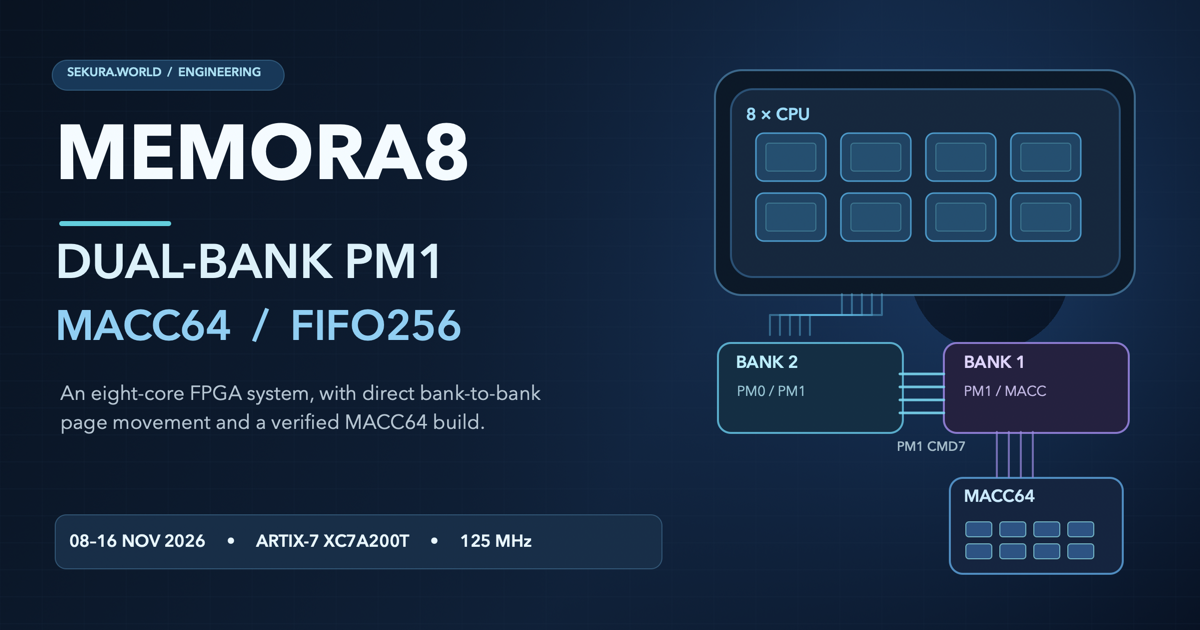
AI Summary: From November 8–16, 2026, Memora8 changed the path between its eight-core CPU complex, DDR3 and signed-INT8 accelerator. A new four-page, 32 KiB staging bank isolates CPU-side PM0 traffic from the MACC compute bank. PM1 CMD7 now copies a complete 8 KiB page directly between the two banks without a DDR3 round trip. The MACC8 arithmetic datapath narrowed from 128 bits to 64 bits—eight signed INT8 products per compute beat rather than sixteen—while the output interface grew to 256 partial signed32 results and a 256-entry FIFO. Ethernet page endpoints were relocated. The integrated main FPGA image routed at 125 MHz with +0.025 ns setup WNS and +0.029 ns hold WHS; 21/21 recorded BX72 regression scenarios passed, followed by verified SPI Flash programming and boot. The aligned
mr8simpassed 42/42 CTest; on macOS with Verilator 5.050, architectural RTL-versus-simulator differential checks passed 22/22 instruction commits and 16/16 branch commits, alongside four passing targeted RTL suites. These checks have defined scope rather than proving whole-system cycle equivalence. Intermittent WSL/UDP sequence retries remain an unresolved observation. Full MobileNetV3 FPGA inference and live-camera capture are not yet demonstrated.
Engineering period: November 8–16, inclusive. This continues our November 1–7 engineering report without dropping November 8. The evidence includes actual Git diffs, current RTL, hardware/Vivado reports and fresh simulator/Verilator tests run on Mac. Each verification level is identified separately.
The main question this week was not how many more operations an accelerator could advertise, but how to put the right bytes in front of it without creating a hidden shared-memory conflict.
Memora8 is our custom eight-core, 32-bit SystemVerilog computer implemented for the AMD/Xilinx Artix-7 XC7A200T on the BX72 board. It combines shared SRAM, external DDR3, a System Bus, multiple PageMover engines, networking, cryptography, storage and a hardware signed-INT8 multiply-accumulate device called MACC8.
The earlier MACC8 report described a 128-bit compute path and a 128-result queue. This week’s design makes general CPU staging and compute input storage into different banks, introduces a direct transfer between them, and changes the compute/result-width tradeoff. It is a substantial hardware revision, but not itself a new measured neural-network inference result.
1. The Engineering Week at a Glance
The Memora8 main history has 13 commits dated November 8–16, including the feature merge and the November 16 simulator update. That is a history count, not thirteen independent deployed features.
| Area | Retained change | Evidence level |
|---|---|---|
| BRAM storage | New 32 KiB staging bank2, four 8 KiB pages | RTL, physical PM/bank tests |
| PM1 / PM0 | Direct PM1 CMD7 bank copy; PM0 removed from MACC bank1 | RTL, Verilator, BX72 regression |
| MACC8 | 64-bit arithmetic path; eight signed INT8 products/beat | RTL, routed FPGA, board tests |
| Partial sums | N=1…256; private FIFO256 × signed32 | RTL, Verilator, hardware |
| Ethernet | RX/TX page endpoints shifted by four pages | RTL, internal MAC loopback |
| Device contract | BUF_OWNED width12, MACC CAP 0x00010040 |
RTL and device discovery checks |
| Main bitstream | Vivado 125 MHz timing pass; JTAG, Flash verify and boot | Hardware |
mr8sim |
Aligned bank2, CMD7, MACC64 and FIFO256 | CTest 42/42 and scoped Mac differential |
| WSL UDP | Sporadic first-pass MR8P SEQUENCE=3 |
Passed on retry; unresolved transport issue |
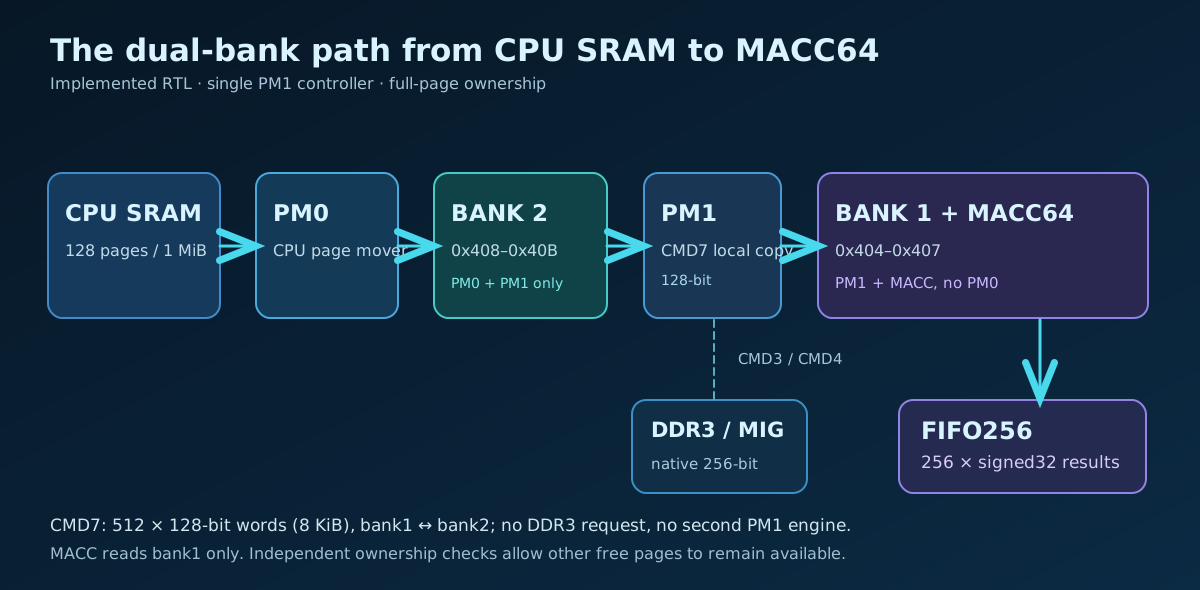
Figure 1. Retained RTL architecture, not a proposed fast path. CPU-prepared data enters bank2 through PM0, then PM1 CMD7 copies the full page into compute-only bank1. DDR3 uses the same PM1 controller but is not part of the CMD7 copy.
2. A Second Bank, With a Different Job
Memora8’s physical PageMover endpoints transfer full 8 KiB pages of 2,048 words × 32 bits. The existing four MACC input pages were at 0x404..0x407. The newly added 0x408..0x40B range provides another 32 KiB of BRAM with a distinct purpose.
- Bank1, compute-only: PM1 and MACC8 may access its pages. PM0 is forbidden.
- Bank2, CPU/DDR staging: PM0 and PM1 may access its pages. MACC8 does not compute from it.
- PM1 remains one controller, sharing its DDR3/MIG interface with its new local-copy functionality.
The complete special-page map is now:
| Bank | Page references | Role | Allowed owner |
|---|---|---|---|
| 0 | 0x400..0x403 |
RAW / microSD staging | PM0, PM2 |
| 1 | 0x404..0x407 |
MACC operand bank, 32 KiB | PM1, MACC8 |
| 2 | 0x408..0x40B |
New DDR/CPU staging, 32 KiB | PM0, PM1 |
| 3 | 0x40C..0x40F |
Ethernet RX page buffers | PM0 source |
| 4 | 0x410..0x413 |
Ethernet TX page buffers | PM0 destination |
These are physical page references, not System Bus DEVICE_REF addresses. The CPU’s ordinary cluster SRAM remains 128 pages, or 1 MiB.
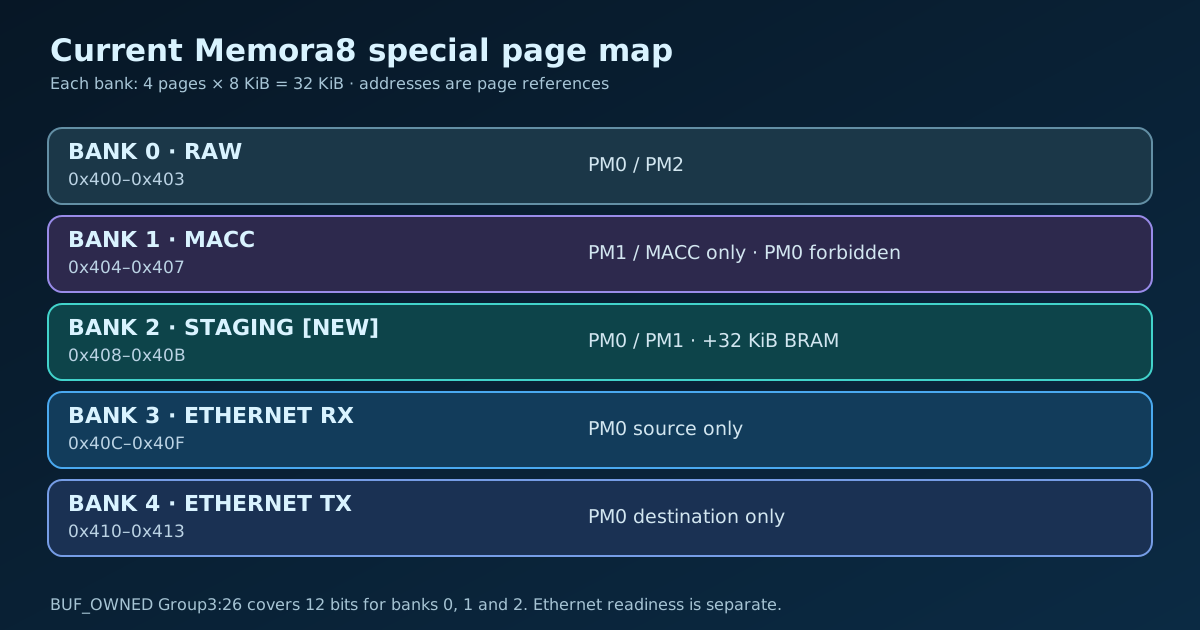
Figure 2. The special-page map after the change. The former Ethernet RX range now holds DDR/CPU staging, and both Ethernet ranges move upward. Bank1 remains the only MACC operand source.
CMD7: a local page copy rather than a DDR3 round trip
PM1 is FunctionDevice Group16:1 / 0x201. The new CMD7 takes a source page in bank1 or bank2, a destination page in the opposite bank, and zero flags. Both pages are reserved atomically, and both are released after the last transferred word.
A page contains 512 × 128-bit words. PM1 reuses the existing 128-bit local read/write path to copy it directly. CMD7 issues no DDR3 requests and requires no additional large FIFO. If either page conflicts with a current owner, the request returns BUSY instead of racing silently.
The CPU-to-accelerator path is therefore explicit:
CPU SRAM → PM0 → bank2 → PM1 CMD7 → bank1 → MACC8
CMD7 works in both directions. DDR3-to-bank and bank-to-DDR3 transfers still use PM1’s CMD3/CMD4, with the existing 128-bit local interface packed toward the native 256-bit DDR3/MIG boundary. The optional CMD3 DATA2[0] byte-wise XOR 0x80 conversion now applies to DDR3 reads into bank1 or bank2. It does not apply to CMD7.
The BUF_OWNED register at Group3:26 covers 12 buffered pages: four RAW, four MACC and four staging. MACC8 can compute from bank1 pages while PM1 handles other nonconflicting pages. This does not create a second parallel PM1 command engine.
3. MACC64: Why Narrower Does Not Mean a Smaller API
The hardware is still named MACC8, referring to its signed INT8 operands, but its instantiated compute datapath is now 64 bits, instead of 128 bits. Importantly, the data-transfer/operand interface is still 128 bits:
| Property | Earlier MACC128 | Current MACC64 |
|---|---|---|
| Signed INT8 products per compute beat | 16 | 8 |
| Compute width | 128 bits | 64 bits |
| Local host / PM1 port | 128 bits | 128 bits |
| Partial-result FIFO entries | 128 | 256 |
| Maximum output partitions per job | 128 | 256 |
The engine processes the low and high 64-bit halves of a 128-bit operand stream over consecutive compute beats. A full two-page job requires 1,024 arithmetic beats instead of 512, plus pipeline latency. Those are datapath counts, not end-to-end throughput measurements and not a quantified FPGA resource saving.
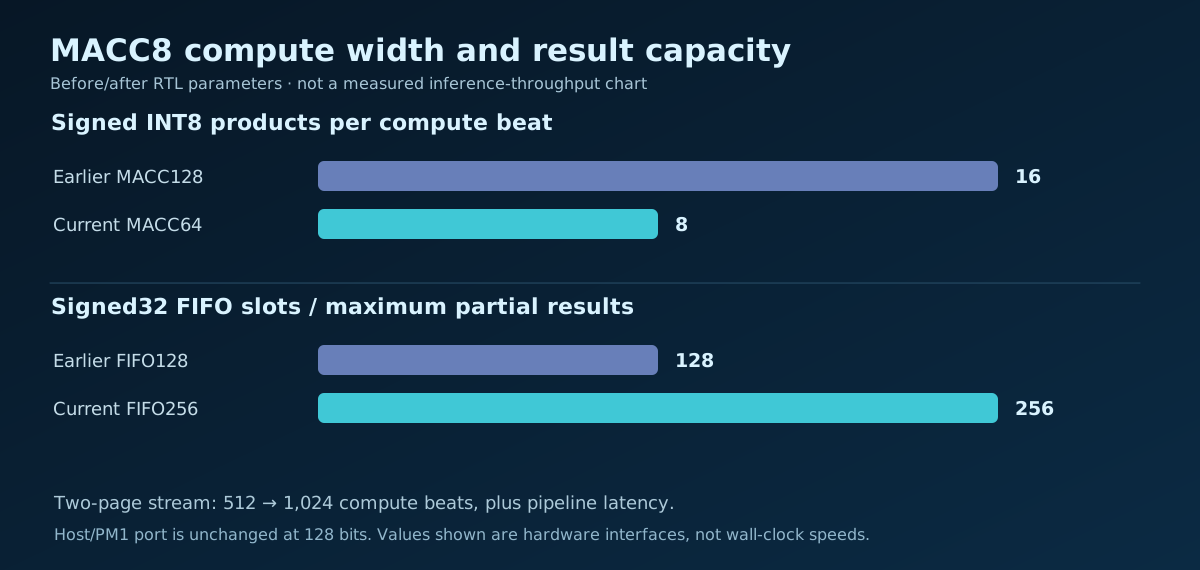
Figure 3. RTL parameters rather than performance measurements. Compute products per beat decrease from 16 to 8. FIFO capacity and maximum number of partial results both increase from 128 to 256.
The extended START command now offers N=1, 2, 4, 8, 16, 32, 64, 128 or 256 signed32 partial results. The top mode is log2(N)=8, encoded with word31 bit23 as the high mode bit while bit22 remains EXT_START.
| Mode | Output sums N | Products/sum, two pages | Products/sum, single-page split |
|---|---|---|---|
| 0 | 1 | 8,192 | 4,096 |
| 1 | 2 | 4,096 | 2,048 |
| 2 | 4 | 2,048 | 1,024 |
| 3 | 8 | 1,024 | 512 |
| 4 | 16 | 512 | 256 |
| 5 | 32 | 256 | 128 |
| 6 | 64 | 128 | 64 |
| 7 | 128 | 64 | 32 |
| 8 | 256 | 32 | 16 |
The device retains two-page A/B, single-page split A=B, SQUARE and USE_K signed-coefficient operations. More partitions mean shorter partial reductions, not additional full-length MACC jobs.
Its own FIFO 256 × 32 bits = 1,024 bytes, accessed as Group9:5 / 0x125, supports INFO, POP, PEEK and STATUS/count. MACC hardware pushes the results; the CPU reads them. An accepted new START clears unread FIFO results, so software must drain the queue before reusing the device. FIFO-nonempty and MACC-DONE remain independent events.
MACC8 CMD1 CAP now reports 0x00010040, describing the 64-bit compute path. The DEVICE_INFO operand width of 128 bits is correct and describes a different interface. The legacy START command remains supported.
A 256-entry FIFO does not by itself implement a convolutional-network runtime. It is useful only when the software chooses partitioning, operands and subsequent reductions that match a real operator.
4. Ethernet Was Shifted, Not Reinvented
Bank2 now occupies the earlier Ethernet RX page range, so the Ethernet buffers move:
| Ethernet endpoint | Previous range | Current RTL range |
|---|---|---|
| RX page buffer | 0x408..0x40B |
0x40C..0x40F |
| TX page buffer | 0x40C..0x40F |
0x410..0x413 |
The Ethernet control device FD17:1 / 0x221, short-frame FIFOs 0x123 / 0x124, and readiness registers Group3:24/25 retain their identifiers. Only their special page references changed. Software that assumes Ethernet RX starts at 0x408 must update its page routing.
The integrated FPGA regression confirmed Ethernet MAC loopback on the current image. That is not a new external physical-wire throughput measurement. The separately measured physical Ethernet rates in the preceding report belong to their dated firmware, not automatically to this bitstream.
5. The New Main FPGA Bitstream and Live BX72 Tests
The updated system was built with Vivado 2025.2 for the BX72 Artix-7 XC7A200T-2 at 125 MHz. The main-branch bitstream completed routing and passed its checked setup and hold constraints.
| Implementation measurement | Verified value |
|---|---|
| System clock target | 125 MHz |
| Setup worst negative slack (WNS) | +0.025 ns |
| Hold worst hold slack (WHS) | +0.029 ns |
| Total setup / hold negative slack | 0 / 0 |
| Successfully routed nets | 191,591 / 191,591 |
| Live FPGA regression scenarios | 21 / 21 PASS |
The 25 ps positive setup margin is real, but narrow. It is not a guarantee that unrelated future logic will fit or meet timing.
The checked main image’s SHA-256 is:
45B4B6D84BA6369F4349532E86A035B6B727329F0B01053F1AA25E8ACDC766C3
The 21 recorded hardware scenarios exercised arithmetic, ISA on all eight CPUs, all 128 SRAM pages, MMU, System Bus/control, BLAKE3, Ed25519, CPU motion and streaming, low/high DDR3 pages, parallel page operations, serial controller configuration, camera configuration, internal UART, Ethernet MAC loopback, PM-buffer transfers and MACC64/FIFO256.
The MACC banks test checked four N=256 operand forms: two-page vector, single-page split, SQUARE and USE_K. Two initial checks returned MR8P SEQUENCE=3 in the WSL/UDP transport, then passed on their second attempt. The suite therefore finished 21/21 PASS with retries, not with a perfectly reliable UDP transport. The cause remains under investigation.
After JTAG testing, Vivado converted the same main image into an SPIx1 configuration image, wrote it to MX25L12872F SPI Flash, verified it and booted the FPGA. The logs include MR8_FLASH_VERIFY_PASS and MR8_FLASH_BOOT_DONE=1. Post-Flash MACC-banks/FIFO256, PM-buffer and Ethernet MAC-loopback checks all passed, and the final CPU running mask was zero.
This verifies the FPGA configuration and Flash boot, not the separate Reganta operating-system boot sequence.
6. RTL and Simulator Verification Completed on Mac
The changes to page addresses, page ownership, PM1 and MACC8 also required a synchronized mr8sim functional model. The November 16 commit b69448f updated the simulator to represent:
- New bank2 and the shifted Ethernet RX/TX addresses.
- PM0 forbidden on MACC bank1.
- PM1 DDR3 transfers to either bank, plus CMD7 direct bank-to-bank copying.
- MACC64 computation, N=1…256, FIFO256 and capability
0x00010040. - The new 12-bit
BUF_OWNEDmask.
The simulator audit reports 42/42 CTest PASS, with a language-program run of 2,426 retired instructions.
The macOS build host has Verilator 5.050. The RTL suites and direct comparison tests are completed successfully on Mac:
| Test on Mac | Outcome | Verified scope |
|---|---|---|
| Buffer devices RTL | PASS | PM1 streaming, XOR80, page locking, MACC64 |
| MACC buffer/FIFO RTL | PASS | Signed INT8 modes, FIFO256, events, errors |
| Buffer cluster RTL | PASS | System Bus, PM1/DDR3, ownership |
| MACC FIFO cluster RTL | PASS | Extended START, discovery, DONE/nonempty events |
RTL ↔ mr8sim commit trace |
22/22 MATCH | Architectural instruction commit records |
RTL ↔ mr8sim branch commit trace |
16/16 MATCH | Architectural branch-program commit records |
For the differential tests, the two scripts built the RTL testbench with Verilator 5.050 and compared ordered traces to the built mr8sim executable. Their actual output was MR8_RTL_SIM_COMMIT_MATCH 22/22 and MR8_RTL_SIM_BRANCH_COMMIT_MATCH 16/16. Both completed without differences.
These are verified architectural trace matches for the named test programs, not a formal assertion of full SoC cycle-by-cycle equivalence. The simulator remains a functional and approximate-timing model for some SRAM arbitration, native DDR3/MIG bursts, DSP register sequencing and external PHY behavior. The four targeted RTL passes separately establish their stated component-level contracts.
7. What Was Actually Retained in Git
The main engineering transitions can be traced to commits rather than assumptions about a release name:
| Revision | Subject and retained effect |
|---|---|
2a378c0 |
Added bank2, N=256 MACC mode and shifted Ethernet pages |
41dbb5d |
Corrected 12-bit BUF_OWNED device passport |
9a066be |
Isolated MACC bank1 from PM0 and implemented PM1 CMD7 |
6bfc96d |
Reduced MACC arithmetic width to 64 bits |
9d0cfaf |
Removed obsolete placement constraints for the former compute width |
f392707 |
Merged the RTL feature branch into main |
221457b |
Recorded verified main FPGA, JTAG regression and Flash deployment |
b69448f |
Aligned mr8sim with bank2, PM1 CMD7 and MACC64/FIFO256 |
The preceding week’s MobileNetV3 Small QAT and first-convolution work remains important. The new MACC output partitioning and buffer ownership do not mean that the network’s remaining operators or full execution graph are now implemented on FPGA.
8. What Remains to Be Verified
Implemented and tested: the current buffer map, PM1 CMD7, MACC64/FIFO256, Ethernet remapping, 125 MHz integrated bitstream, 21 hardware tests, Flash boot, four Mac RTL suites and two architectural trace comparisons.
Unresolved: the positive 25 ps setup slack is small. Some initial WSL/UDP transfer requests still encounter MR8P SEQUENCE=3 before retry; the root cause has not been determined. The functional simulator does not claim cycle accuracy for all external-device interactions.
Not demonstrated by this release: live OV5640 video capture, physical GPIO/sensor wiring, external UART jumpers, sustained physical Ethernet throughput stress, destructive/high-address SD validation, or complete MobileNetV3 FPGA inference.
Next, the data-staging and accelerator schedule should be measured together—including CPU preparation, PM0, PM1 CMD7, MACC64 and result consumption—instead of interpreting compute beats as application throughput. The same exact Flash image should be used for independent physical Ethernet stress testing, and transport retries should be diagnosed separately.
9. Frequently Asked Questions
Did the second bank add a second DDR3 controller?
No. It adds four BRAM pages = 32 KiB. Both banks share a single PM1 controller and existing DDR3/MIG connection. CMD7 performs a local 8 KiB copy, not a second independent DDR3 transfer.
Does MACC64 mean the data interface is only 64 bits wide?
No. The compute datapath is 64 bits, while the host operand and PM1 ports stay 128 bits. The MACC capability word and device passport accurately describe different interfaces.
Does FIFO256 provide 256 neural-network output channels?
No. It holds up to 256 signed32 partial results for one configured MACC8 job. Software selects the partitioning and performs any subsequent reduction.
Did the Mac RTL-to-simulator comparison finish?
Yes, for its explicit scope. With Verilator 5.050, the targeted RTL suites passed, and the differential architectural commit traces matched 22/22 and 16/16 records. These results should not be expanded into an untested claim of global waveform equivalence.
Is the main FPGA configuration installed in Flash?
The recorded November 16 deployment succeeded. The specific main image was written, verified, booted and functionally checked again. This describes the tested deployment, not any unknown later reprogramming.
10. Conclusion
Memora8 now has a clearer boundary between CPU-staged data and accelerator-owned compute pages: bank2 belongs to staging, bank1 to computation, and PM1 CMD7 explicitly copies between them with page-level ownership. MACC64 trades arithmetic width for a larger, more flexible result interface; Ethernet’s special buffer pages move to accommodate the new bank.
The outcome is more than a design proposal: the integrated FPGA image met timing, passed its live board regression and booted from verified SPI Flash. The simulator and its RTL checks also have completed, reproducible Mac results, including architectural trace comparison.
The next stage is to connect these verified primitives to application scheduling and end-to-end measurements, without confusing them with a finished inference engine, OS boot or physical camera pipeline.
Further reading
- Memora8 Weekly: November 1–7 — QAT, earlier MACC and FPGA measurements.
- MACC8 Computation and Memory Optimization — accelerator baseline.
- Eight-Core FPGA System — full platform overview.
- System Bus and SBI Reference — software/device command contract.
- Reganta Boot Sequence — distinct OS startup architecture.
Evidence note: Memora8 Git revisions 2a378c0 through b69448f; mr8/docs/DDR3_BANK2_MACC256.md, mr8sim/RTL_SYNC_20261116.md, Vivado timing and BX72 live regression/Flash logs. Mac verification used Verilator 5.050, four targeted RTL executable suites, and the architectural trace scripts compare_commit_with_rtl.sh and compare_branch_with_rtl.sh, with 22/22 and 16/16 matches respectively. Hardware timing, simulation, differential trace matching and full application inference remain distinct levels of evidence.